
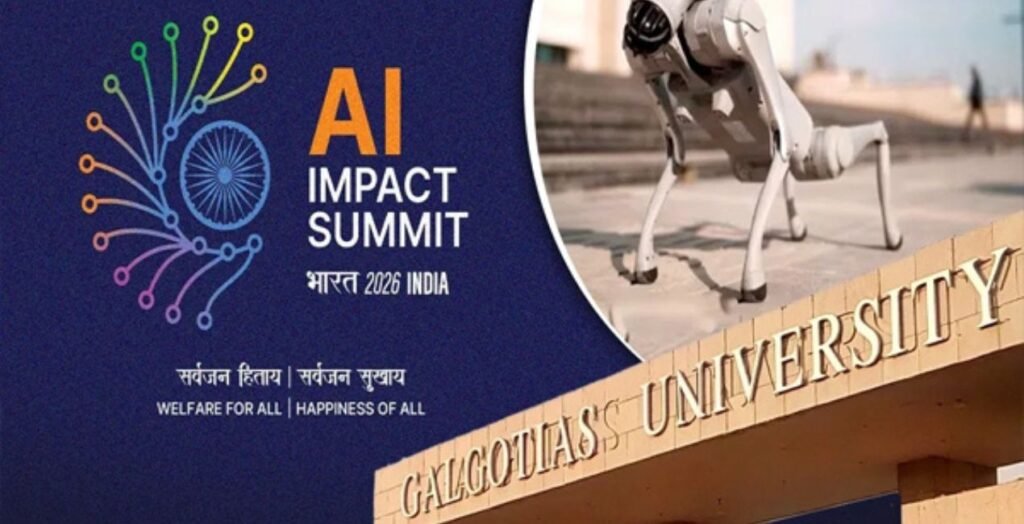
The AI Summit Incident: What Actually Happened?
The Grand Showcase
The India AI Impact Summit 2026 was designed as a platform to celebrate India’s advancements in artificial intelligence, robotics, and emerging technologies. Leading institutions, startups, and tech innovators gathered to display their projects.

Galgotias University participated enthusiastically, presenting what was described as an advanced quadruped robotic system. Visitors at the stall were reportedly told that the robotic dog was developed or significantly engineered by the university’s internal research team.
The presentation attracted attention — but not in the way the institution might have hoped.
Social Media Detectives Step In
Tech enthusiasts and robotics professionals who attended or saw footage from the event began comparing the showcased robot to the Unitree Go2, a well-known quadruped robot manufactured in China.
Side-by-side comparisons circulated rapidly online. Observers pointed out similarities in structure, hardware design, and movement patterns. Soon, hashtags began trending, questioning whether the robot was truly an original innovation.
Within hours, what started as a campus exhibition turned into a national discussion on transparency in academic research.
The Fallout: Public Reaction and Institutional Response
Official Scrutiny
Reports indicated that summit organizers intervened after concerns were raised. The matter reportedly drew attention from the Ministry of Electronics and Information Technology, which oversees digital and technological initiatives in India.
Authorities emphasized the importance of authenticity and factual representation at national-level technology events. Exhibitions at such summits are expected to uphold credibility, especially when representing academic research.
Shortly after the controversy gained traction, Galgotias University issued a clarification. The institution described the situation as a “miscommunication” by a representative and apologized for any misunderstanding.
Public Debate Intensifies
Despite the clarification, debates continued across social media. Critics argued that universities must maintain rigorous standards when presenting technological achievements. Others defended the institution, suggesting that collaboration or demonstration models are common in tech exhibitions.
The divide highlighted a larger tension — between innovation marketing and genuine research development.
Academic Branding vs. Academic Integrity
The Pressure to Impress
In today’s competitive education landscape, universities are under immense pressure to stand out. Rankings, placements, partnerships, and research output are closely scrutinized. Participation in global tech summits is seen as a way to enhance reputation.
However, the Galgotias controversy revealed the risks of prioritizing visibility over verification. When institutions attempt to amplify their innovation image, even small inconsistencies can severely impact credibility.
The Age of Instant Verification
In 2026, transparency is no longer optional. With access to online databases, product catalogs, and AI-powered image comparison tools, audiences can verify claims almost instantly.
Universities operate in an environment where every demonstration can be recorded, analyzed, and shared globally within minutes. This incident underscored how quickly public opinion can form — and how difficult it is to reverse once trust is questioned.
Broader Implications for Indian Higher Education
Innovation Ecosystem Under Scrutiny
India has positioned itself as a global technology leader, investing heavily in AI, robotics, and semiconductor initiatives. Academic institutions play a central role in this vision.
When controversies arise at national technology platforms, they risk undermining broader innovation narratives. Stakeholders — including investors, policymakers, and international collaborators — closely observe how institutions represent their research capabilities.
Student Impact
Controversies also affect students. Social media discussions often blur lines between administrative decisions and student contributions. Many students at Galgotias University were reportedly concerned about how the incident might affect internship opportunities, placements, or perceptions of their degrees.
In competitive industries like AI and robotics, institutional credibility matters. Even isolated events can influence brand perception.
Lessons Learned from the 2026 Controversy

1. Transparency is Non-Negotiable
Institutions must clearly specify whether a product is:
Fully developed in-house
A collaborative project
A commercial product used for demonstration purposes
Clear communication prevents misinterpretation and protects institutional integrity.
2. Fact-Checking Before Public Display
Before participating in large-scale exhibitions, universities must ensure:
Claims are technically accurate
Representatives are trained to communicate precise information
Marketing materials align with documented research contributions
In the digital age, oversight can quickly become public controversy.
3. Reputation Management is Strategic
How an institution responds matters as much as the controversy itself. Prompt acknowledgment, transparency, and corrective communication can reduce long-term damage.
Delays, defensiveness, or vague explanations tend to intensify criticism.
Was It Miscommunication or Misrepresentation?
One of the central debates remains unresolved in public discourse. Supporters of the university argue that the robotic dog may have been used as a demonstration platform integrated with software developed by students. If that were the case, clearer communication could have avoided backlash.
Critics, however, maintain that academic platforms require precision. Any ambiguity — especially when innovation claims are involved — invites scrutiny.
The truth may lie somewhere in between. But the controversy revealed how thin the line can be between showcasing technological ambition and overstating capability.
The Role of Social Media in Academic Accountability
This incident also demonstrated how social media now acts as a decentralized accountability mechanism.
In previous decades, such disputes might have remained confined to internal discussions. Today, viral posts, comparison videos, and expert commentary shape narratives instantly.
For institutions, this means:
Every claim is subject to real-time audit
Public relations strategies must adapt to digital speed
Institutional communication must be proactive rather than reactive
Moving Forward: Rebuilding Trust
For Galgotias University, the path forward involves reinforcing its research transparency and highlighting verified achievements. Universities often recover from controversies by demonstrating sustained commitment to authentic innovation.
This could include:
Publishing detailed research documentation
Hosting open technical demonstrations
Encouraging third-party validation of projects
Trust, once questioned, requires consistent effort to rebuild.